Supabase vs Firebase in 2026: Which Should You Choose?
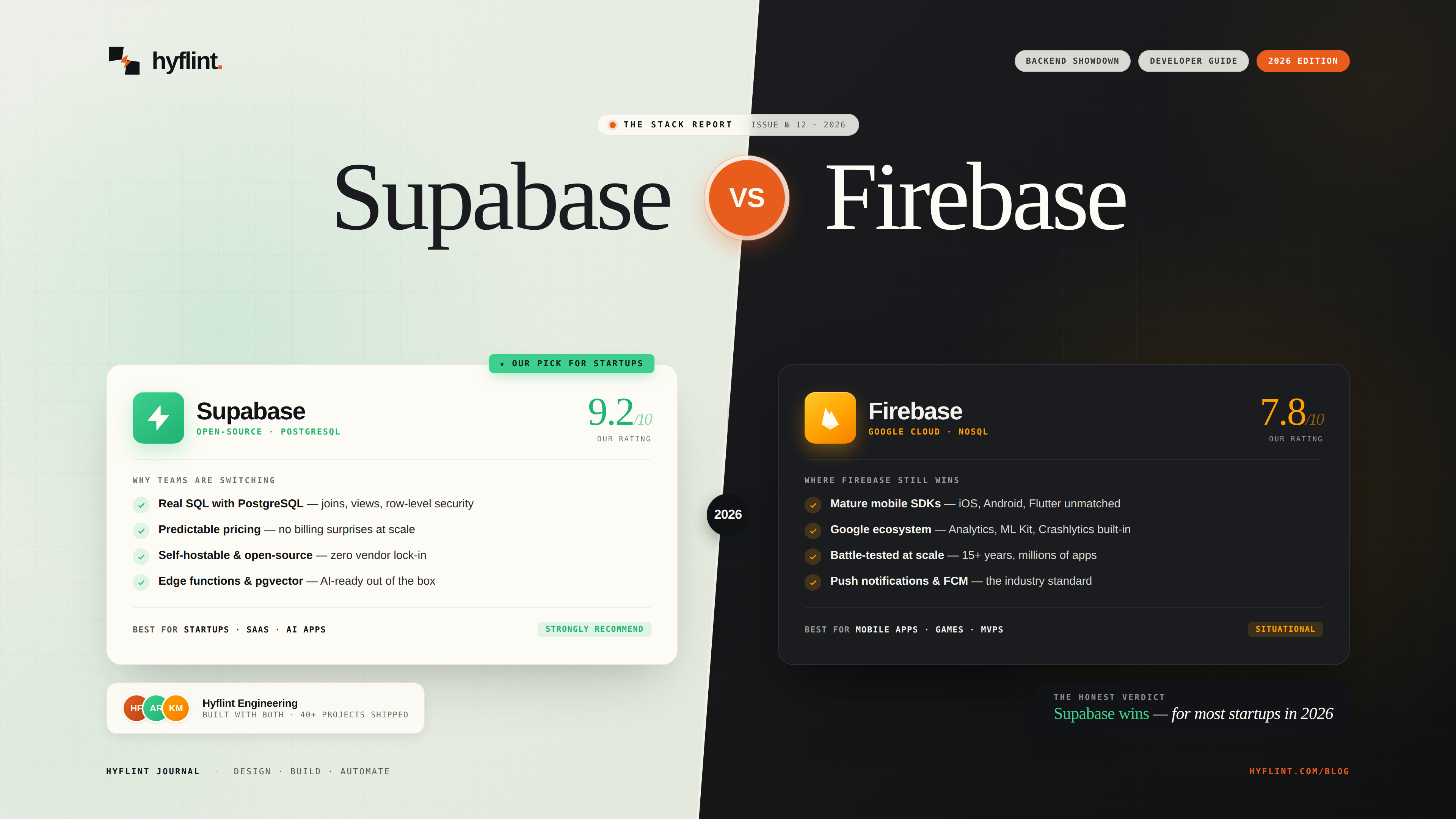
An honest comparison from a team that builds with both. Supabase wins for most startups — here's why, and when Firebase is still the better choice.
Hyflint Team
Product Studio
TL;DR
| Factor | Supabase | Firebase |
|---|---|---|
| Database | PostgreSQL (relational) | Firestore (NoSQL) |
| Pricing | Predictable, generous free tier | Pay-per-read/write (can spike) |
| Vendor lock-in | Low (open-source, standard Postgres) | High (proprietary) |
| Real-time | Built-in | Built-in |
| Auth | Built-in + social providers | Built-in + social providers |
| File Storage | Built-in | Built-in |
| Edge Functions | Deno-based | Cloud Functions (Node.js) |
| Self-hosting | Yes | No |
| Best for | Relational data, SQL-heavy apps | Real-time apps, rapid prototyping |
Our default recommendation: Supabase. Unless you have a specific reason to choose Firebase (see below).
Why We Default to Supabase
1. PostgreSQL > Firestore for Most Apps
Most applications are fundamentally relational. Users have orders. Orders have items. Items belong to categories. This is what relational databases were built for.
Firestore forces you to denormalize data, duplicate it across collections, and manage consistency manually. It works for simple apps, but the complexity explodes as your data model grows.
With Supabase, you write standard SQL. Your data model is normalized. Joins work. Foreign keys enforce consistency. When you hire a new developer, they already know PostgreSQL.
2. Pricing You Can Predict
Firebase's pay-per-read/write model has a nasty surprise built in: a single poorly-optimized query in a list view can trigger thousands of reads. We've seen Firebase bills jump from $50/month to $2,000/month after a product launch because of a missing pagination limit.
Supabase charges by compute and storage — resources you can monitor and predict. The free tier covers most MVPs through their first 10,000 users.
3. No Vendor Lock-in
Supabase is open-source. Your database is standard PostgreSQL. If you ever want to leave, you export your database and point your app at any Postgres host. Migration takes hours, not months.
Firebase is proprietary. Moving off Firebase means rewriting your entire data layer — authentication, database queries, file storage, everything. We've done Firebase-to-Supabase migrations. They typically cost $15,000–$30,000.
4. Row-Level Security
Supabase's row-level security (RLS) lets you define access policies at the database level. "Users can only read their own data" is a one-line policy, not a middleware check you need to add to every API endpoint. This is especially powerful for multi-tenant SaaS apps.
When Firebase Is Still the Right Choice
- You're building a real-time chat app or collaborative editor. Firestore's real-time listener model is more mature and battle-tested at scale than Supabase's real-time.
- Your team already knows Firebase deeply. Switching costs are real. If your team has 3 years of Firebase experience and tight deadlines, stick with what you know.
- You need Firebase ML or Firebase Extensions. Google's ML Kit integration and the extension marketplace have no Supabase equivalent.
- You're building a mobile-first app with offline support. Firestore's offline persistence is excellent. Supabase's offline story is still maturing.
Our Recommendation
For 80% of startups building web-first SaaS products: Supabase + Next.js. It's the stack 36% of Y Combinator startups chose in 2024, and for good reason — it's fast to build with, cheap to run, and you own everything.
For real-time-heavy mobile apps with offline requirements: Firebase + React Native. Google's infrastructure handles the edge cases that would cost you months to build yourself.
Need Help Deciding?
We build with both stacks daily. Book a free call and we'll recommend the right one for your specific product — no agenda, just technical advice.
Need help with this?
We build exactly what this article covers. Book a free call and let's talk about your project.
Start a conversation